
Bitcoin's current price in the $64,000–$65,000 range is giving retail investors a sense of déjà vu and mild anxiety, as this is exactly where the asset stalled during the previous cycle. However, major players see a completely different story in the chart. Tether adviser Gabor Gurbacs said that Bitcoin is now "massively undervalued" at these levels.
His main argument is that the price has remained the same, but the internal structure of the market has been completely transformed.
While the 2021 all-time high was driven by pure hype, regulatory uncertainty, and excessive leverage, by July 2026 the landscape had changed beyond recognition, with spot ETFs, interbank gateways for institutional investors, and clear rules established by governments.
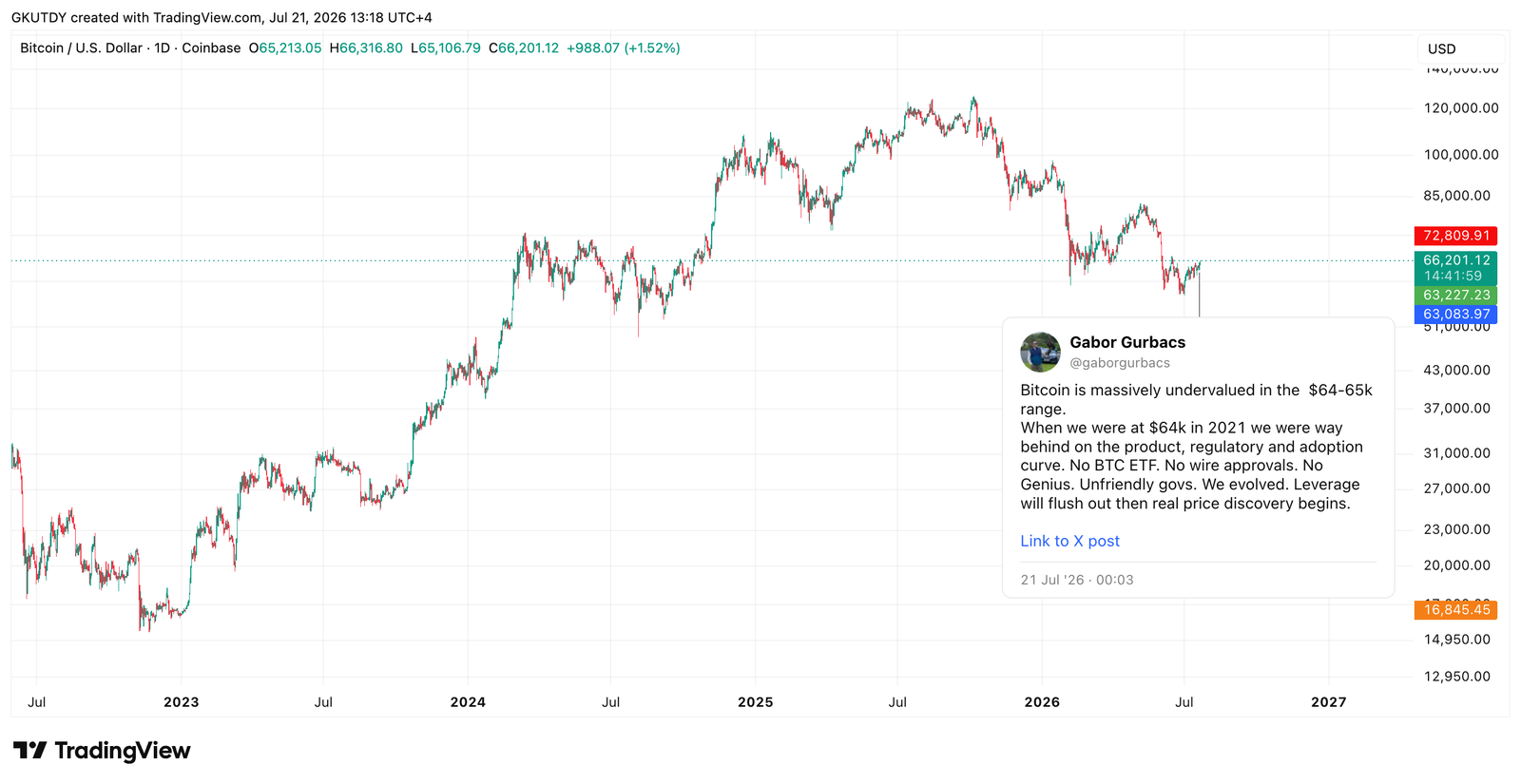
According to Gurbacs, once the market clears out the remaining leveraged speculators, real price discovery will begin.
Why institutional players want $65,000 Bitcoin
Data from the SoSoValue analytics platform supports the Tether adviser's view and closely reflects actual financial flows:
- Funds are buying the sideways market: Major capital is methodically accumulating during the current consolidation. During the July 20 trading session, spot Bitcoin ETFs recorded net inflows of $226.92 million, with these purchases taking place while Bitcoin traded at $65,142.
- Five-day buying rally: Institutional investors are showing consistent interest after closing every session last week with positive inflows ranging from $79 million to $181 million per day. June's outflows have now been fully offset.
- Capital base: Total net assets under management in Bitcoin ETFs have approached $79.16 billion.
Bitstamp's technical chart shows that after the spring correction from the peak near $126,000, Bitcoin found a solid bottom in the $55,700–$58,200 zone. The asset is now holding around $64,210, while indicators, including the daily RSI, suggest that buyers are taking control.
The main conclusion from the current news flow is that the $64,000–$65,000 range is no longer the "dangerous peak" it appeared to be five years ago. For Wall Street, it is now a comfortable accumulation zone and a new reinforced foundation from which major capital is preparing to push the market higher.