
As Bitcoin ($BTC) price signaled an indecisive outlook over the past seven weeks, leveraged long positions recently paid the highest cost since January 20, 2025, thus marking an 18-month-and-29-day peak.
Bitcoin’s funding rates – periodic payments made by long and short traders to anchor perpetual contract prices to spot price to incentivize the less dominant side – hit 0.0228 on August 14, according to data from CryptoQuant analyzed by Finbold on August 18. As such, the asset’s funding rates surged to the highest level since January 20, 2025, when it spiked to 0.02775, thereby revisiting the highest level in 575 days.
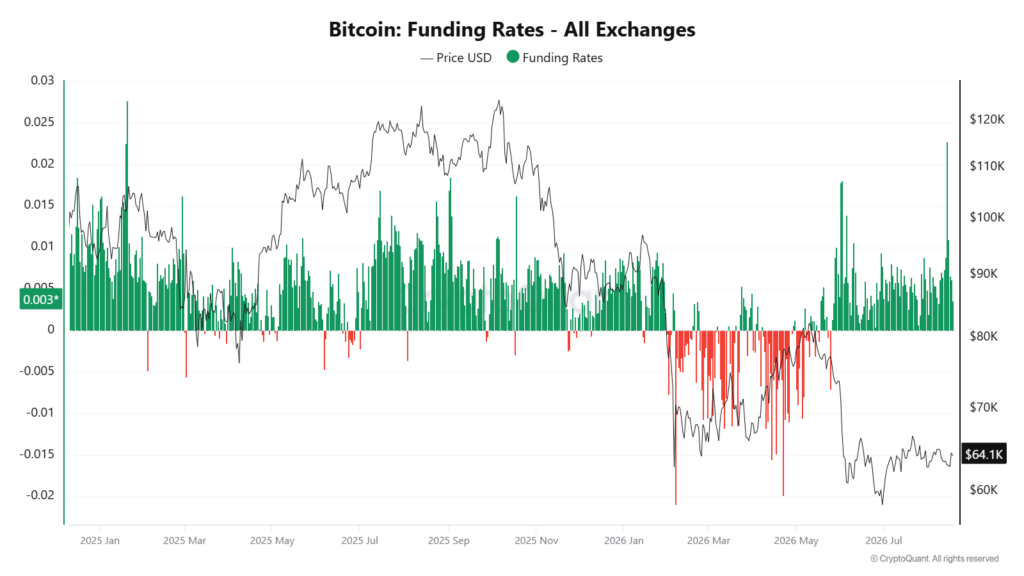
Bitcoin’s funding rates have remained predominantly positive since May 26, 2026. Notably, prolonged positive funding rates happen when long positions are dominant, and vice versa.
Bitcoin derivatives markets heat up
As Bitcoin’s funding rates signaled that more traders are bullish compared to shorts, $BTC Open Interest – Simple Moving Average (SMA) 7, which measures the total number of active derivative positions over the past seven days, surged to the highest level in two months at $22.79 billion, according to metrics from CryptoQuant.
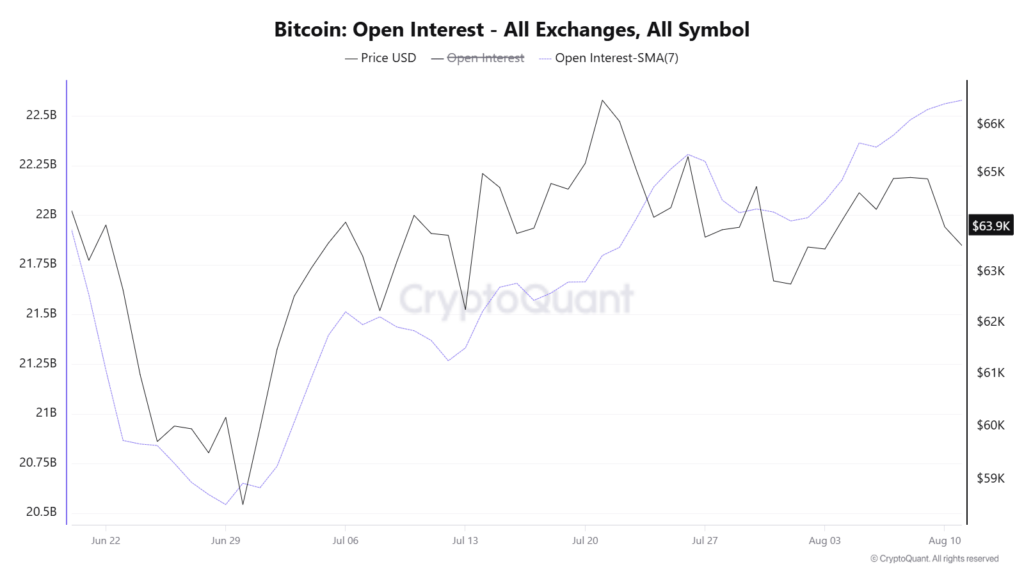
As such, the rising $BTC OI amid predominantly positive funding rates signals that more derivative positions are long.
$BTC price analysis
The last time Bitcoin’s funding rates spiked to such levels amid rising OI, $BTC price capitulated over the subsequent weeks. Specifically, $BTC price traded at around $102,198 in January 2025 but dropped by 25.37% to $76,276 on April 8, 2025.
Nonetheless, $BTC price could be on the verge of a rally towards $76,000 if it holds above $62,300 and consistently closes above $67,200, according to analysis from Aksel Kibar, a former hedge fund manager.
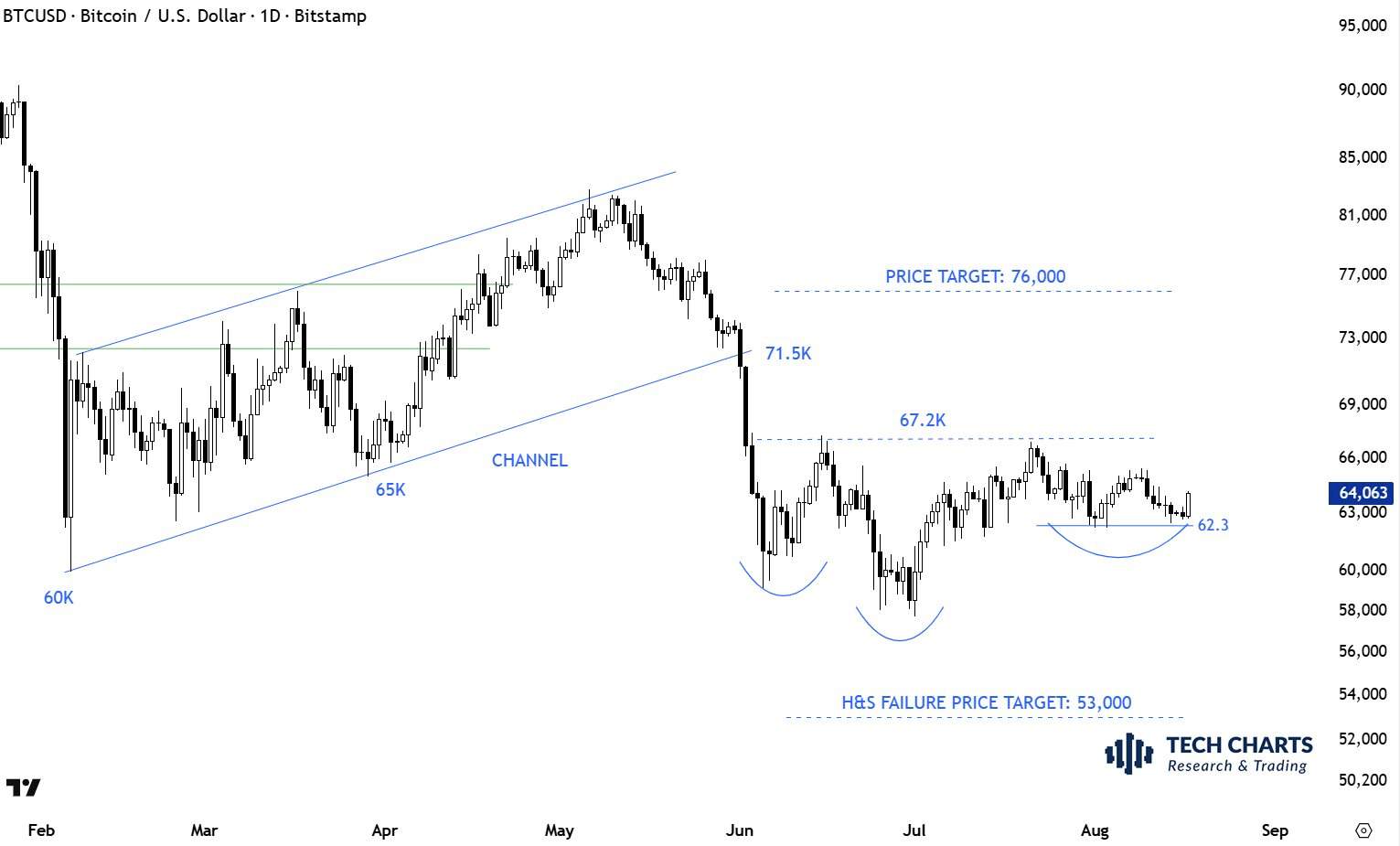
However, if $BTC price falls below its support level near $62,300, this analyst has set a target of $53,000. Such a selloff could be catalyzed by a long squeeze, a situation in which falling prices force long holders to sell, accelerating the decline.
Featured image via Shutterstock