The audited accounts of DTR, the fintech software group acquired by Bakkt in April, show a business that recorded just €5,315 in other income and lost €8.4 million in 2025.
Bakkt had pitched DTR as part of its stablecoin infrastructure push, acquiring it for 11.3 million shares. The accounts classify €5,315 as other income rather than revenue and show an €8,435,181 loss for 2025. They cover DTR’s first consolidated reporting year, contain no earlier comparison, and predate the April 30 closing.
Bakkt acquired all of DTR's outstanding equity. DTR's accounts describe a group providing fintech software, while Bakkt called it a developer of stablecoin and agentic payments infrastructure. Under an earlier cooperation agreement, DTR contributed payments technology, APIs, intellectual property, and personnel, while Bakkt supplied systems access and its regulatory licenses.
Bakkt DTR acquisition reveals cash burn and negative working capital
DTR ended 2025 with €373,857 in cash. Its €1,136,732 of current liabilities exceeded €838,790 of current assets by €297,942. It used €7,784,190 of cash in operating activities and funded itself with €11,718,611 from issuing share capital.
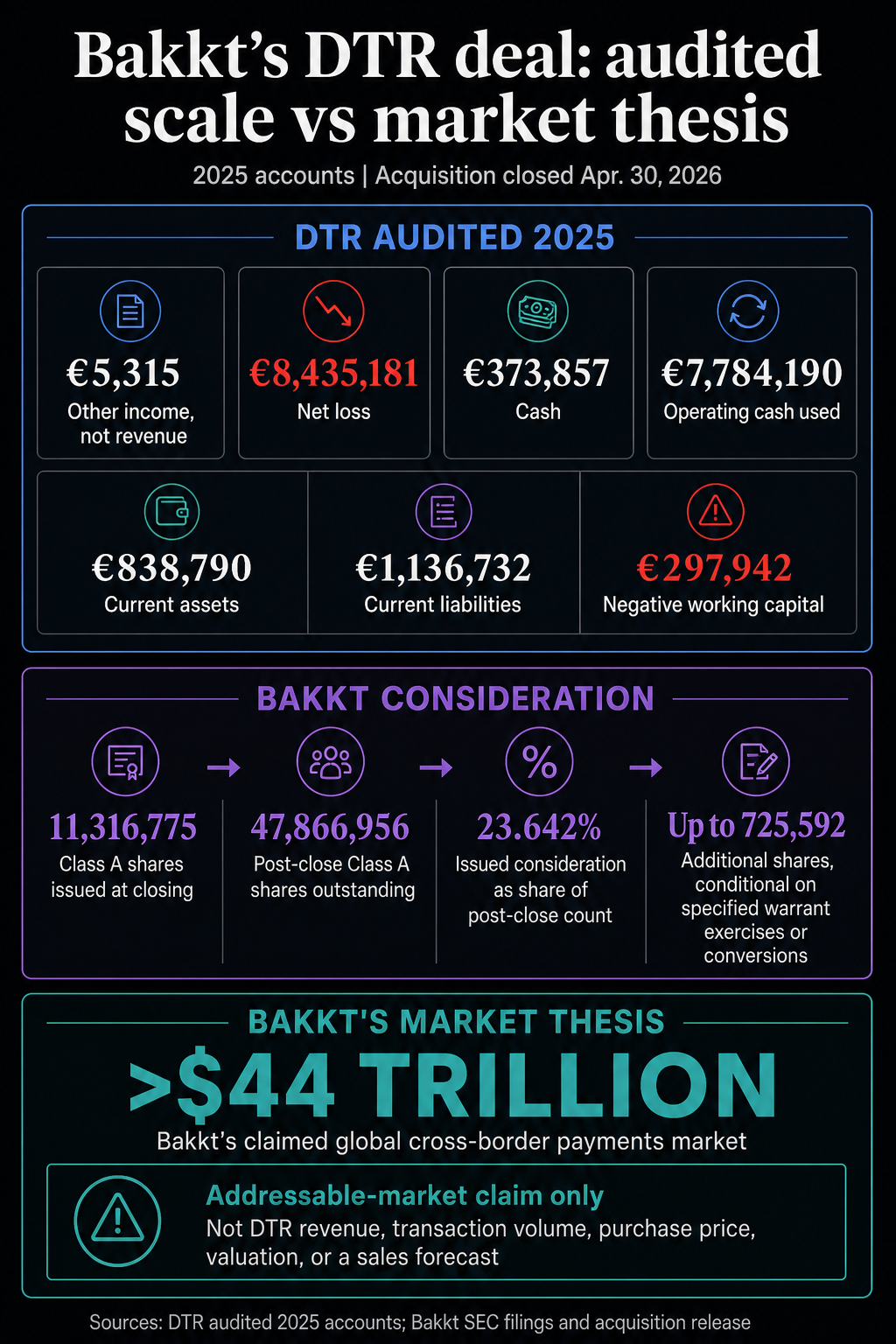
Bakkt issued 11,316,775 Class A shares at closing after reducing the consideration by 196,532 shares for specified shareholder loans and excess transaction expenses. A later registration statement reported 47,866,956 Class A shares outstanding as of April 30, making the issued consideration 23.642% of that post-close count.

That percentage is different from the deal's 31.5% term, which applied to a defined pre-close, as-converted share base. Bakkt may issue up to 725,592 additional consideration shares, but only alongside shares issued through the exercise or conversion of specified warrants. Any calculation including that maximum would also have to add the corresponding warrant shares to the denominator.
Related-party terms and commercial outlook
The deal was a related-party transaction. Akshay Naheta was Bakkt's CEO, president, and a director. He also served as DTR's CEO and principal owner and received 8,322,949 Bakkt shares as DTR consideration. Bakkt said an independent special committee negotiated and approved the deal. Naheta recused himself and abstained, and stockholders approved the issuance before closing.
The accounts recorded a €3,205,828 impairment expense, described as a write-off of a related-party balance. Separately, the cash-flow reconciliation showed a €3,614,868 movement in an amount due from a related party; that was the year's movement, not the €409,040 receivable at year-end.
Bakkt's completion release cast the acquisition as a route into what it called a global cross-border payments market worth more than $44 trillion. That total-market claim is not DTR's revenue, transaction volume, purchase price, or valuation, nor is it a forecast of Bakkt's obtainable sales.
The Bakkt DTR acquisition now faces its commercial test. Bakkt's transaction proxy said DTR had fallen behind forecasts. Three prospective customer integrations were delayed, and expected large merchants did not materialize. The new audited accounts sharpen the gap between the technology Bakkt acquired and the scale it had demonstrated before the purchase.