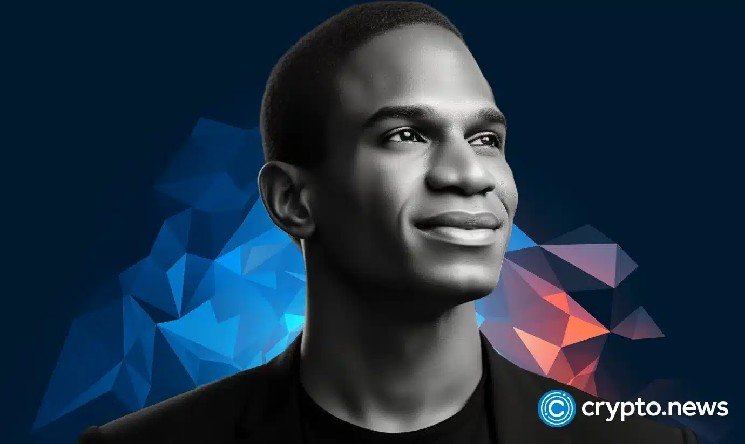
Arthur Hayes has proposed allocating roughly 20% of Flop Network’s FLOP token supply to testnet participants over 10 years as part of a self-funded decentralized computing network for artificial intelligence agents.
Arthur Hayes said in an Aug. 19 Substack article that Flop Network would connect AI agents seeking computing power with miners operating internet-connected hardware, using FLOP as the network’s payment and reward token.
The BitMEX co-founder described the proposed system through a fictional creation story, but the article also provided new information about the project’s token distribution, economic model, and intended users. Hayes said the token launch would follow a fair-start model, with no presale needed because he had funded the development team himself.
Under the planned distribution, people who contribute to the Flop Network testnet would collectively receive about one-fifth of the supply by the end of a 10-year period. Hayes did not disclose the total number of FLOP tokens, the rate at which the testnet allocation would be released, or the activities that would determine each participant’s share.
Flop Network would sell compute through FLOP
Flop Network’s proposed market would price AI workloads according to the number of floating-point operations, or FLOPs, required within a defined period. Miners would process requests using a model selected by the customer and receive payment in the network’s native token.
According to Hayes, current AI services make price comparisons difficult because each model defines and charges for its own input and output tokens differently. He described model tokens as an abstraction of the computing work performed, rather than a standard unit that customers can compare across providers.
Cloud companies already rent computing capacity, but Hayes said their billing systems do not charge customers according to the actual FLOPs consumed. Flop Network would try to create a common spot price for computing work regardless of the model, hardware type, or location of the machine processing the request.
Anyone with an internet-connected computer could become a compute provider under the proposed design. AI agents and human users would submit jobs specifying how much work they require, the time available and the model to be used, while FLOP would settle the transaction.
Hayes wrote that the currency would represent “a claim on compute,” allowing buyers and sellers to establish a consistent price for a given amount of processing work. He called FLOP “food for AI agents” because autonomous software requires computing power each time it performs an inference or completes a task.
FLOP miners would earn two types of rewards
Instead of using computing power only to produce hashes, as Bitcoin miners do, Flop Network would rely on a process called Proof of Useful Inference, or PoUI. Hayes said miners would earn FLOP block rewards for supporting the network and inference fees for completing requests.
The article did not explain how validators would confirm that a miner had used the requested model, completed the correct number of operations, or returned a valid result. As crypto.news previously reported, Flop Labs has not released the technical method for checking nondeterministic AI outputs, detecting incorrect work, or penalizing providers that submit false results.
Public documentation has also not established which blockchain will support FLOP, how many validators will operate at launch, or whether ordinary consumer hardware will be able to compete with dedicated>Flop Network ties testnet use to token distribution
Hayes said the FLOP token would help Flop Network attract miners, agents, and speculators at the same time, addressing the difficulty new networks face when they launch without an existing group of buyers and service providers.
Rather than sell an early allocation to venture investors, Hayes said he had self-funded the team responsible for developing the network. He argued that large presales often leave retail buyers facing an excess supply of tokens after an asset begins trading.
Flop Network would instead distribute roughly 20% of its token supply to testnet users over 10 years. The post did not specify whether the remaining supply would fund mining emissions, validators, contributors, a treasury, or other groups.
Eligibility rules also remain unpublished. Flop Labs has not said whether users will qualify by providing compute, validating jobs, storing agent memories, completing testnet transactions, or promoting the project as a community partner.
Hayes said the distribution should reward people who provide useful work to the network, although his article also claimed participants could become “generationally wealthy” by holding the tokens they receive. The post carried a disclaimer stating that his personal views should not serve as investment advice or a recommendation to make investment transactions.
The project’s Aug. 18 announcement placed a large FLOP airdrop in the fourth quarter of 2026, and the Flop Network genesis block in the first quarter of 2027. Neither the Substack article nor the announcement explained where recipients would hold the token if distribution starts before the native network becomes operational.
U.S. agent payments already favor stablecoins
Flop Network would enter a machine-payment market where dollar-backed stablecoins already process live transactions. A May 2026 Keyrock report found that AI agents had settled $73 million through 176 million transactions over 12 months, with $USDC accounting for 98.6% of the tracked payments.
Keyrock said 76% of those transactions were worth less than the $0.30 fee floor associated with card payments. According to the report, Layer 2 stablecoin transfers cost about $0.0001, making them suitable for small purchases such as API calls, data access, and automated online services.
For U.S. businesses, Coinbase began allowing commercial customers to accept agent $USDC payments through its x402 standard in July. The exchange said an agent can receive payment instructions from an online service, sign a stablecoin transfer, and resubmit its request with proof that it paid.
FLOP would differ from that dollar-based model by giving agents a token tied to the supply of computing work, according to Hayes. His proposal did not explain how miners would cover dollar-denominated electricity and hardware costs when their income comes through a freely traded token, nor did it provide a method for keeping the cost of compute stable when FLOP’s market price changes.
Machine commerce has also raised questions beyond payment settlement. In June, the American Arbitration Association and Integra Ledger introduced legal records for agent transactions, covering consent, governing law, and dispute procedures when software purchases services without direct human review.
Hayes said his next article would explain why the agent economy requires a spot market priced by floating-point operations per unit of time and how Flop Network intends to create it.