Solana is drawing in new types of stablecoins, going beyond $USDT and $USDC. The additional liquidity shows the ecosystem is still growing, with inflows into DeFi and real-world asset (RWA) trading.
Solana is expanding its supply of alternative stablecoins, with $4.81B in total. This liquidity is beyond the usual bridged and native supply of Tether’s $USDT and Circle’s $USDC.
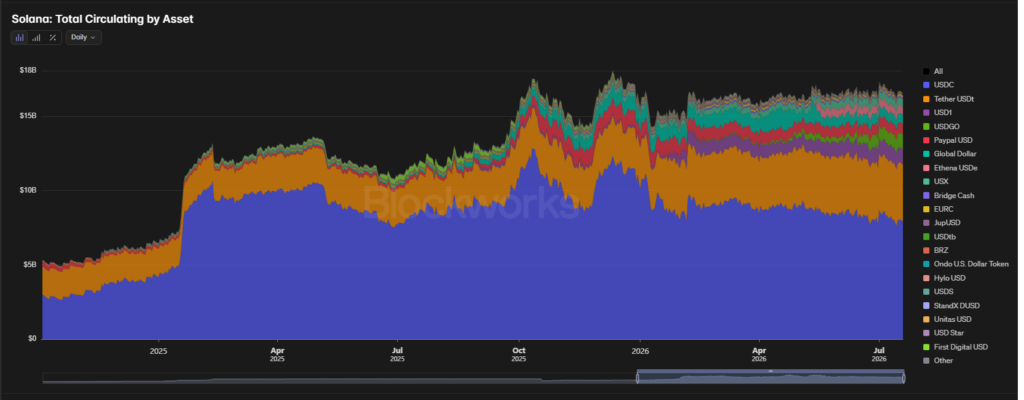
In total, Solana supports $15.15B in stablecoin liquidity, close to its upper range. The crypto market drawdown in 2026 has not removed liquidity from the chain.
Solana’s alternative stablecoin liquidity is led by USD1, the native stablecoin of World Liberty Fi. USDGo is the second-largest alternative stablecoin with recent supply growth.
USDGo reflects a new wave of stablecoins linked to banking entities, and potentially in agreement with the upcoming Clarity Act in the USA. The stablecoin is issued by Anchorage Digital and surpassed $1B in supply just five months after launching. USDGo also expanded its supply by 65% in the past month, based on Solana on-chain data.
The distributor of USDGo, OSL, is also one of the few fully MiCAR authorized entities in the EU.
The Solana economy keeps growing
The Solana economy is a mix of meme speculation and utility apps, aiming to mimic the financial system. Solana drew in $288M in new inflows for the past three months, based on Artemis data.
The chain is also the venue for consistent revenue-generating apps. On Solana, apps drew in $4.6M in fees, with $2.24M in revenues.
As of July, memes are not the biggest source of fee production. Jupiter’s aggregator is the leading app on Solana, followed by the most active DEX and DeFi protocols. The Solana economy is still a mix of speculative and mature markets. Currently, RWA and other financial markets are holding the larger share of liquidity, while speculative activity secures app revenues.
The chain already supports over 300K owners of real-world assets (RWA), becoming one of the most influential chains for tokenized securities.
As Cryptopolitan reported earlier, Solana tops all other chains in terms of RWA ownership. Over $1.75B is held in tokenized stocks, as Solana benefits from the shift from token trading to equities.
Solana stablecoins accelerated minting in June
Solana stablecoins are growing due to demand for perpetual futures trading, RWA, and DEX. On the project side, the stablecoin supply also grew as smaller projects accelerated minting.
As of July, $USDC is still the most widely used stablecoin on Solana, with 58.2% of value locked. $USDT has a share of around 27%. PyUSD is in the third place with 4.9% of liquidity. The representation of alternative stablecoins and their share may depend on reporting methodology, leading to disparities in exact market share.
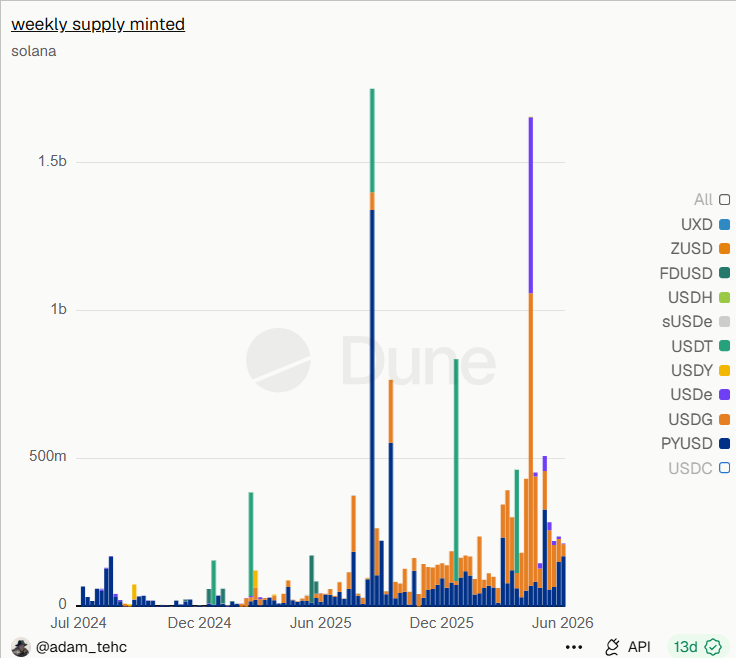
At the same time, small-scale stablecoin projects are the most active minting entities. In the past two months, Global Dollar ($USDG) saw the most active minting, rising up to 4.6% of total stablecoins on Solana. Overall, Solana’s supply of smaller alternative stablecoins has now grown 15 times since January 2025.
In 2026, new $USDT minting on Solana was minimal. Tether’s stablecoin is still widely used on Ethereum and TRON, but lags on Solana. The stricter requirements of Europe’s MiCAR and the upcoming Clarity Act in the USA are making some traders more skeptical of $USDT as a settlement tool.