
Algorand [$ALGO] attracted renewed whale attention as its price approached a potential breakout on the 3rd of August.
Large holders increased their exposure across Spot and derivatives markets. This activity accelerated as $ALGO reclaimed its 20-day Exponential Moving Average (EMA).
By the 4th of August, $ALGO traded at $0.08908, according to CoinMarketCap. This placed it marginally above the earlier $0.089 target.
Why are $ALGO whales buying?
AMBCrypto’s analysis of the altcoin’s derivatives data found that whales continued accumulating rather than reducing their exposure.
Consequently, whales held 54% of $ALGO’s supply on the 3rd of August. This strengthened their influence over its near-term price direction.
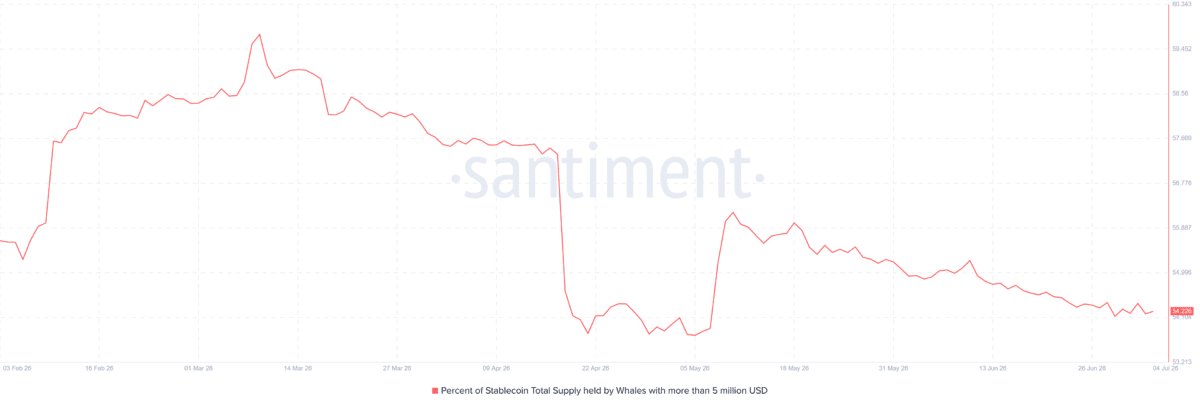
Their bullish positioning extended beyond the Spot market.
Long positions represented 57% of tracked derivatives exposure. This suggested that most leveraged traders expected further price gains.
Whale accumulation alongside a long bias typically reflects growing market confidence. However, such positioning could also increase liquidation risks if $ALGO reverses.

Can $ALGO hold above $0.089?
$ALGO’s daily chart showed momentum shifting toward buyers on the 3rd of August.
The token had consolidated inside a bullish pennant before reclaiming its 20-day EMA. That move suggested buyers were regaining short-term control.
At the time, pennant resistance remained the next hurdle. A breakout could carry the altcoin toward $0.089, where earlier rallies faced selling pressure.
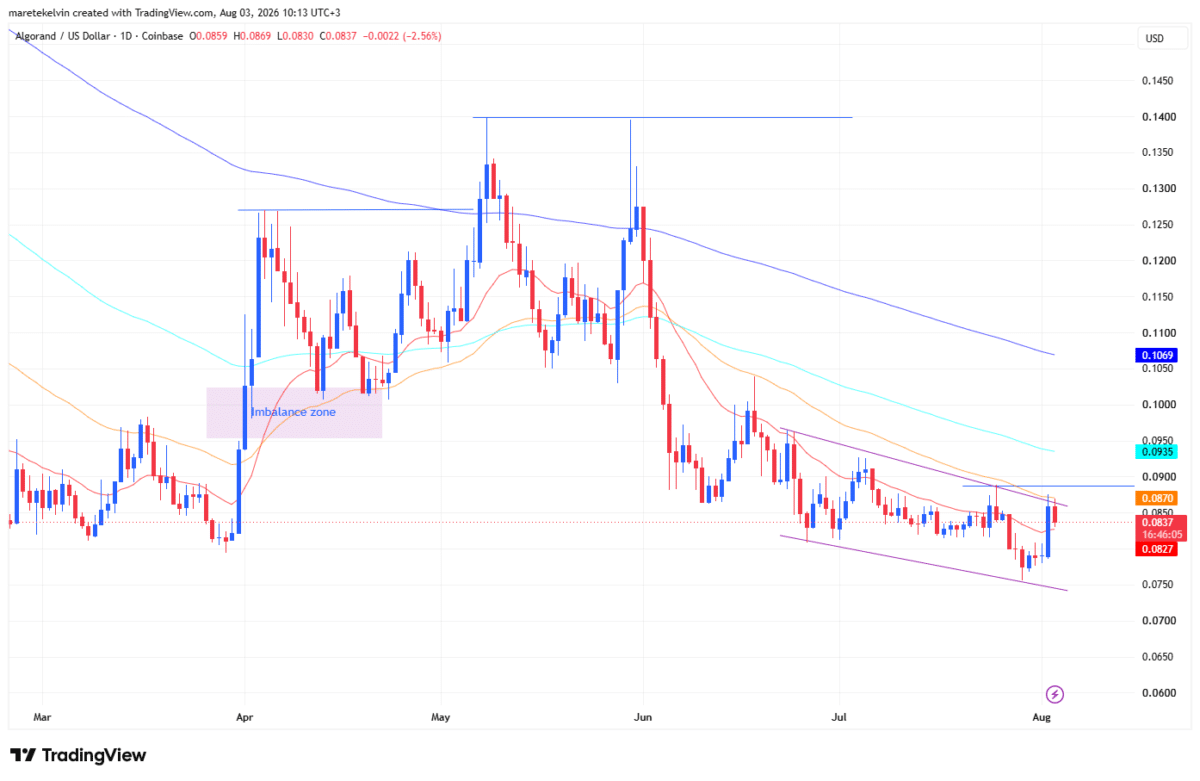
That target was reached by the 4th of August, when $ALGO traded at $0.08908.
Whale ownership remained elevated, while long positions dominated tracked derivatives exposure. Algorand had also moved above its key moving average.
However, holding above $0.089 may determine whether the breakout develops into a broader rally. A rejection could return the token toward its former pennant range.
Final Summary
- Large holders controlled 54% of $ALGO’s supply, strengthening their influence over its price direction.
- Long positions represented 57% of tracked derivatives exposure, reflecting expectations of further upside.