
The crypto-tax discussion in Germany has become significantly more political. The right-wing party Alternative for Germany (AfD), which has made headlines with its call to maintain the low 12-month tax that Bitcoin enjoys, secured a victory in the recent state election in Saxony-Anhalt.
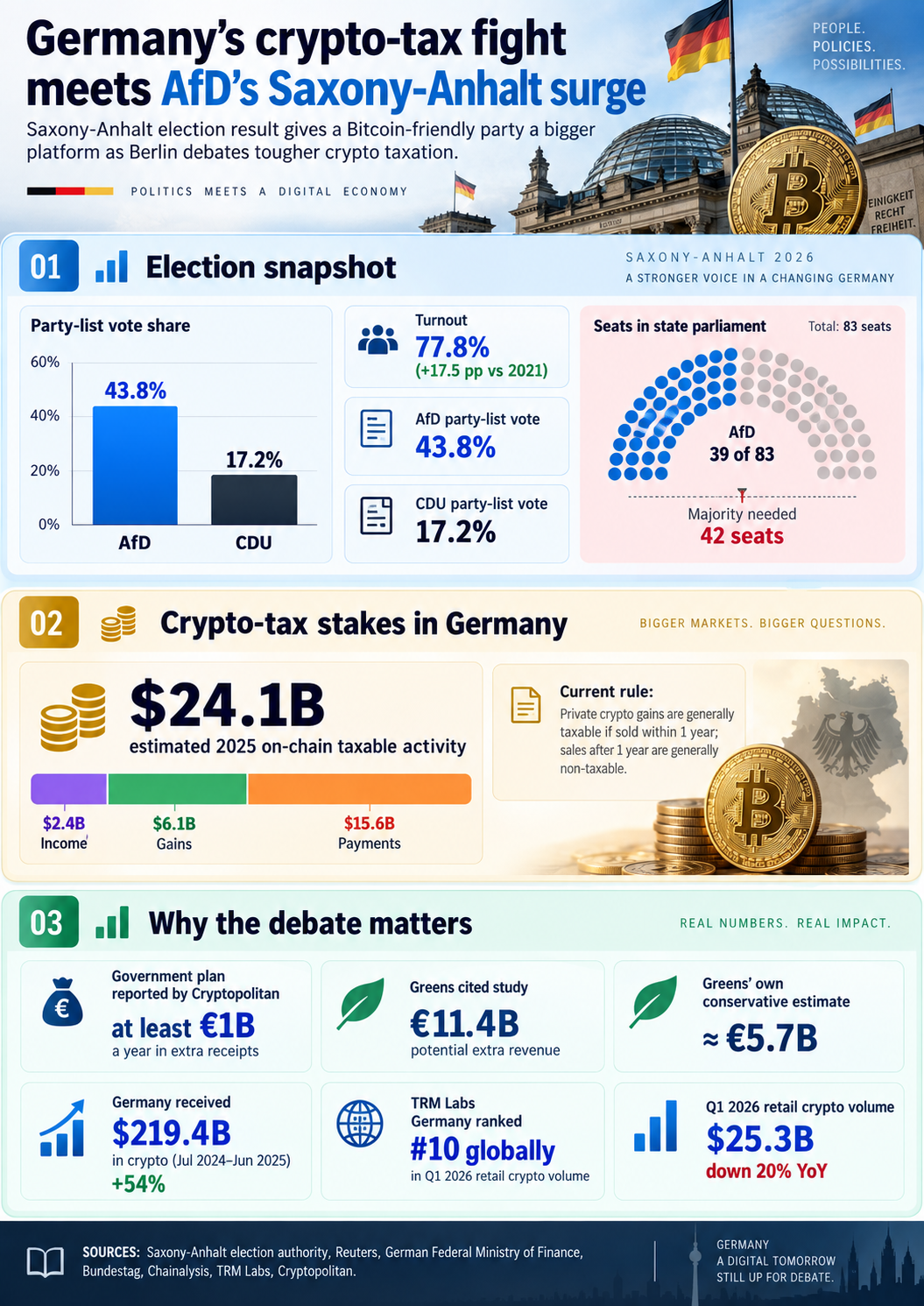
While the outcome in the state does not trigger any changes to the federal law or add any seats to the AfD in the Bundestag, it gives the AfD a platform for its agenda as Berlin gears up for new tax regulations in a market that generated $24.1 billion in on-chain taxable activity in 2025, according to Chainalysis’ estimates.
The AfD gathered 43.8% of party list votes and 44.3% of the first votes from 2661 polling districts, while Chancellor Friedrich Merz’s CDU party dropped to 17.2% of the party-list votes, a decline of almost 20 percentage points, compared to 2021. Voter turnout increased by 17.5 points to 77.8%.
A far-right first place that rattled Berlin
Reuters reports that Merz ruled out any collaboration with AfD, declaring that the outcome made the CDU shaken “to its very foundation.”
AfD got 39 of the total of 83 seats, just three away from a majority. The party’s co-head Tino Chrupalla called on the CDU lawmakers to help create what he called “a center-right conservative majority,” furthering the pressure on the traditional “firewall” against cooperation with the radical right.
According to Reuters, the AfD is anti-immigrant and pro-Russia. Its branch in Saxony-Anhalt has been designated as right-wing extremist by the domestic intelligence agency of the region. Co-head Alice Weidel called the outcome a breakthrough and confirmed that the party is looking to gain at least 40% in the 2029 federal elections.
Where the AfD stands on Bitcoin
The AfD’s attitude towards cryptocurrency can be traced back to even before the party was successful in the elections. In a Bundestag motion dated October 23, 2025, the party stated that Bitcoin is “decentralized, non-manipulable, and limited-availability,” and therefore needs to be treated differently from other cryptocurrencies.
It called for Bitcoin to be excluded from MiCA, for the 12-month holding period to remain, and for private mining and Lightning-node operation not to be treated as commercial activity.
That position resurfaced in May, when the AfD opposed a Greens bill to remove the holding period. The party argued that government should tax fewer activities and focus spending on core state functions.
The exemption Berlin wants to scrap
Germany’s Finance Ministry guidance says gains on privately held crypto are taxable when acquisition and disposal are no more than one year apart. Sales after that period are generally non-taxable.
The 2027 budget plan approved by the cabinet states that new tax regulations on cryptocurrencies will be implemented, but the summary provided does not clarify the mechanism. Cryptopolitan reported earlier, based on reports from Germany, that Berlin plans to eliminate the one-year tax exemption and try to raise at least €1 billion every year.
The Green Party attempted the change previously, and it had advanced a bill on May 6 that would require private disposal of crypto assets to pay personal income tax irrespective of holding period. It failed when it went before the committee on May 20. The party took a Frankfurt School study that estimated €11.4 billion of extra revenue but then took into consideration only half of that amount in their calculations to stay conservative.
Why the stakes reach beyond one state
Germany is a major crypto market. Chainalysis estimated $24.1 billion in 2025 taxable activity, including $2.4 billion in income, $6.1 billion in gains and $15.6 billion in payments.
Separately, Chainalysis recorded $219.4 billion received in Germany from July 2024 through June 2025, up 54%. TRM Labs ranked Germany tenth globally for Q1 2026 retail crypto volume at $25.3 billion, down 20% year over year.
That scale gives the tax fight relevance beyond Germany. Removing the holding-period exemption could change long-term investor behavior and intensify competition among European jurisdictions for crypto capital and users. Saxony-Anhalt cannot decide federal tax policy, but the AfD’s result gives one of the loudest opponents of the change a stronger political megaphone just as the debate moves forward.