
Key Highlights
- Aave’s founder, Stani Kulechov, has praised the UK’s new tax policy for crypto lending and liquidity pools.
- On July 13, HMRC introduced a “No Gain, No Loss” (NGNL) rule for crypto lending and liquidity pools, which means that deposits into protocols like Aave will no longer trigger immediate capital gains tax.
- The new tax policy is a major breakthrough for the UK’s crypto users as it makes lending and liquidity pools more tax-friendly for everyday users.
On July 13, the biggest lending protocol, Aave’s founder, Stani Kulechov, publicly shared his excitement over the United Kingdom’s new tax legislation for cryptocurrency lending and liquidity pools (LPs).
“HMRC in the UK is adopting new tax legislation related to crypto lending and liquidity pools,” Kulechov stated.
Aave Founder Says UK’s Tax Policy for Crypto is In the Right Direction
The main change is that depositing funds into lending protocols will now be treated as ‘no gain, no loss’ for tax purposes. This means that users won’t owe capital gains tax until they actually sell, withdraw, or otherwise dispose of the asset in a way that realizes a gain. Aave’s founder also clarified that the collateral backing these deposits will not be subject to capital gains tax either.
Aave Founder Kulechov called the new development by the U.K. regulators the “right direction” for the crypto sector and said industry feedback helped prove that other options would have been too complicated for taxpayers. “Positive about the HMRC approach because 1) it proves that the industry can affect the eventual outcome (similar how we did with the £20,000 stablecoin holding cap) and 2) seeing more tax legislation around DeFi means the space has progressed in meaningful way,” stated in the post on X.
UK’s New Policy Introduces ‘No Gain, No Loss’ Model for Crypto Lending
The policy comes from HMRC (His Majesty’s Revenue and Customs)’s consultation on how to tax decentralized finance (DeFi) activities involving lending and staking of crypto assets. The official document introduced strong support for the “no gain, no loss” model.
Under the previous U.K. tax rules, depositing crypto into lending protocols or liquidity pools could count as a taxable event. This has triggered capital gains tax even if the consumer did not sell the asset. This policy has created “dry” tax charges, tax bills without any actual cash profit. This leads to complex tracking and reporting headaches.
The proposed NGNL treatment changes this;
- The new tax policy will consider deposits into lending protocols or certain liquidity arrangements as tax-neutral.
- Capital gains tax is postponed until the user makes an “economic disposal”, such as an actual sale or exchange that realizes value.
- Collateral in borrowing arrangements is generally not subject to capital gains tax during the loan period.
The new tax policy is expected to show the reality of these transactions while applying to both DeFi and some centralized finance setups. HMRC is making new amendments to the existing policies after getting input from stakeholders, with the inclusion of automated market maker (AMM) and other common DeFi activities.
The official document stated that “HMRC published a call for evidence which was open from 5 July 2022 to 31 August 2022 seeking views on the taxation of cryptoasset loans and liquidity pools. This was followed by a consultation that ran from 27 April 2023 to 22 June 2023. Since the consultation HMRC has continued to engage with stakeholders on the design of the rules.”
According to the official announcement, the measure will take effect from 6 April 2027.
The policy is expected to boost DeFi adoption in the U.K. By removing immediate tax obstacles, it will reduce legal ambiguity around the crypto regulations for users and institutions. This will directly benefit lending platforms like Aave. Kulechov mentioned that “This is the right direction, mainly driven by the industry feedback demonstrating that any other approach would cause significant admin burden for the taxpayer.”
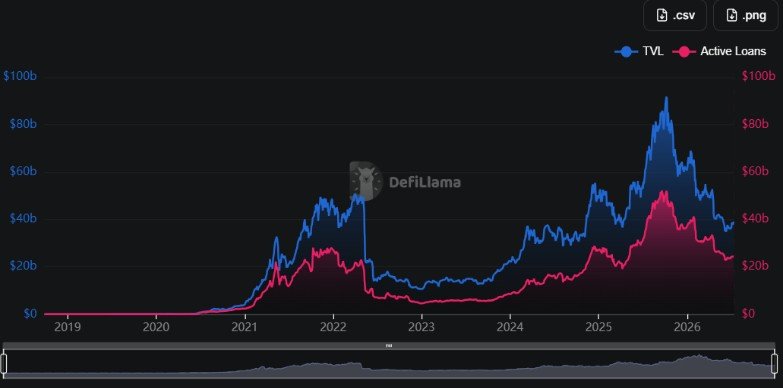
(Source: DeFiLlama)
The global DeFi lending sector is one of the most active sectors of decentralized finance (DeFi). As of now, the total value locked in all lending protocols is currently around $38 billion, according to DeFiLlama. Aave is leading the list of lending protocols with more than $13.30 billion in TVL.
Amid growing regulatory clarity around the cryptocurrency sector across the globe, such as the CLARITY Act, the DeFi sector is witnessing growing adoption, as it boosts investors’ confidence.