
According to the most recent data, open interest in Shiba Inu derivatives is declining on eight of the ten exchanges. When traders withdraw from $SHIB futures, it might initially seem like a bear market. Declining leverage, however, may actually improve the asset's health and lessen one of the main risks affecting its price in the current market structure.
Open interest descending
The value of open positions in derivatives that have not yet been closed is measured by open interest. In general, declining OI indicates that positions are being closed more quickly than new ones are being created. That pattern is precisely what $SHIB displays. Open interest fell by 3.37% on OKX, 11.31% on KuCoin, 2.02% on Gate, 2.12% on Bitget, and 4.08% on MEXC.
While dYdX was marginally negative, LBank and WhiteBIT also saw contractions. The only exchanges that showed increases were Bitunix and HTX. In many instances, trading volume is declining even more quickly. KuCoin's $SHIB derivatives volume decreased by nearly 70%, Bitget by 41%, and MEXC by roughly 34%.
This suggests that speculative activity has significantly decreased. Because less open interest translates into less systemic leverage, why might that benefit $SHIB? Highly leveraged markets are susceptible to liquidation cascades, in which long positions are liquidated by a comparatively slight price decline, forced selling drives the price lower, and the subsequent layer of liquidations ensues.
Technical picture dominates here
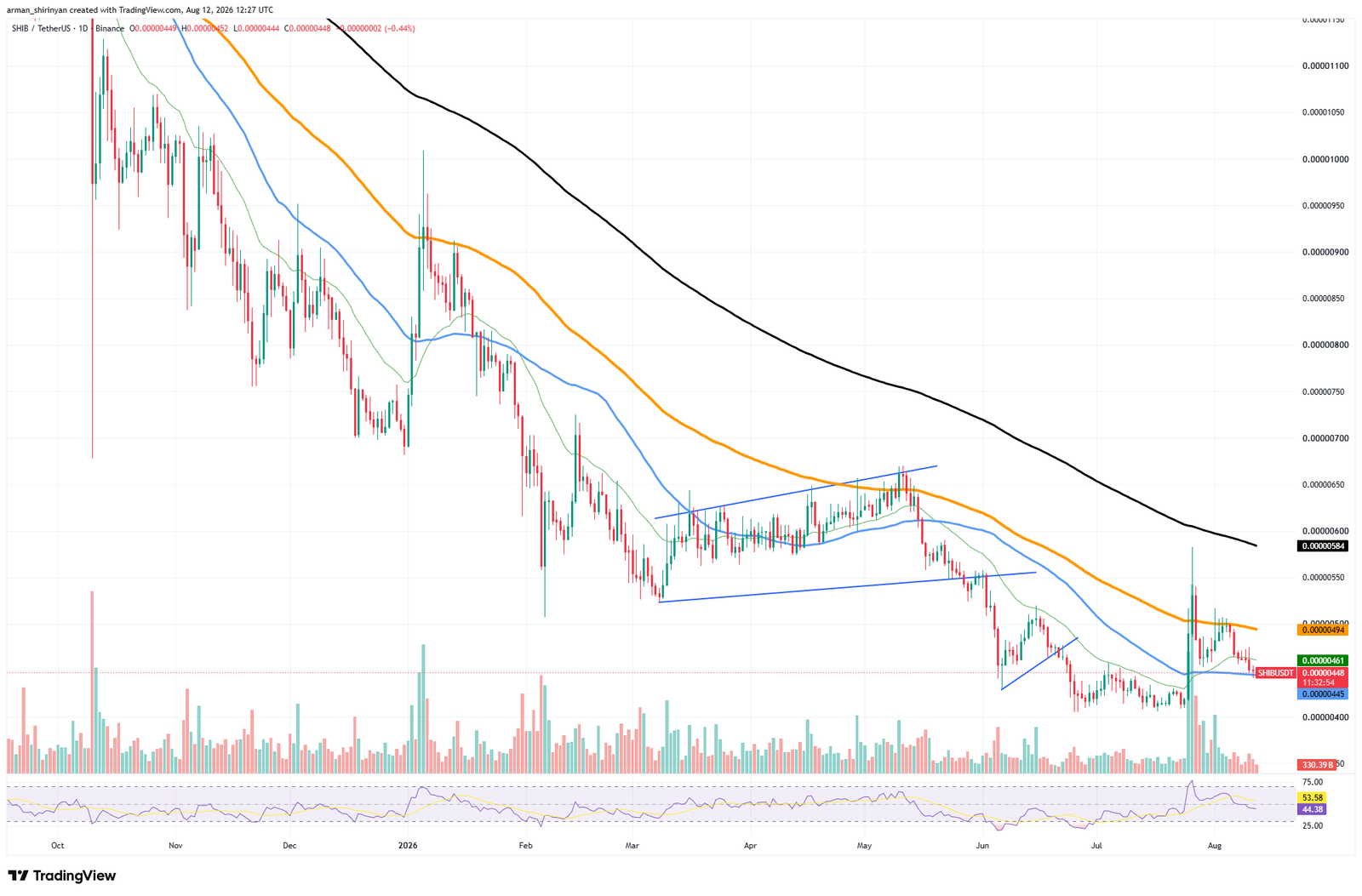
Eliminating a few of those positions lowers the risk of mechanical downside. This is especially important in light of the price chart. Following months of weakness, $SHIB is currently trading at $0.00000448 and is still below major moving averages. Additionally, a sustained breakout was not established by the recent spike toward $0.0000058.
It could be argued that excessive futures leverage would worsen the market's fragility rather than aid in its recovery. Falling OI is not intrinsically bullish because of this. Derisking may also be a sign of dwindling trader interest, and real spot demand is still required for $SHIB to reverse its broader downward trend.
However, there is a crucial difference between removing a risk and providing fuel for a rally. The former is not provided by declining open interest. It is able to supply the latter. The market may eventually approach its next attempt at recovery with fewer speculative positions capable of converting normal volatility into another liquidation-driven sell-off if $SHIB stabilizes while leverage keeps resetting.