
After about 16.5 years of total inactivity, seven Bitcoin wallets from the Satoshi era have abruptly become active, moving a total of 350 $BTC worth about $28 million. On-chain data indicates that 50 $BTC were transferred by each wallet. Less than 15 months after the launch of the Bitcoin network in January 2009, the coins were created from mining rewards earned in March 2010.
Unexpected surge of activity
The movement is especially strange given how old the coins are. At the time, Bitcoin's block reward was 50 $BTC, so the seven wallets held rewards for each of the seven initial mining blocks. Each initial 50 $BTC reward is now valued at nearly $4 million at current prices close to $79,850. The owners may not be selling based solely on the transfers.
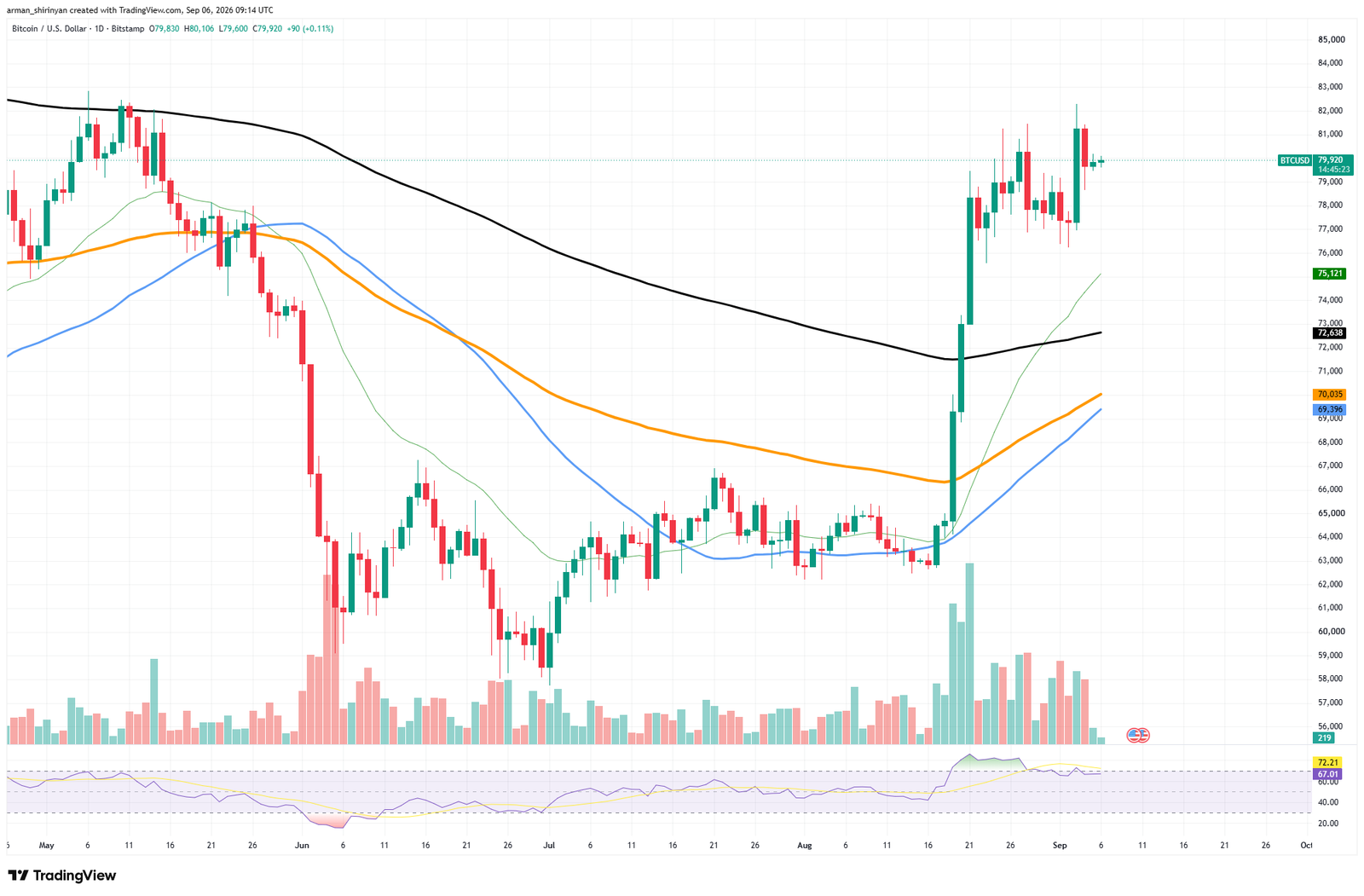
The transactions by themselves don't offer much proof of impending selling pressure unless the coins later arrive at an exchange or another recognizable liquidity venue. However, given that Bitcoin is currently trading close to $80,000 following a dramatic rebound, the timing merits consideration.
According to the daily chart, Bitcoin is currently trading at about $79,850 after momentarily rising above $81,000. With the 20-day average close to $75,116, the 200-day average around $72,637, and longer intermediate averages between $69,000 and $70,000, the asset is still comfortably above its major moving averages. After the quick advance, momentum has somewhat subsided.
Momentum is still bullish
The daily RSI is currently at 66.9, which is consistent with strong bullish momentum, even though it is below overbought territory. The $81,000–$82,000 area continues to be the immediate technical obstacle, as multiple recent attempts to prolong the rally have run into opposition.
In comparison to the typical daily trading volume of Bitcoin, the 350 $BTC transfer is a negligible sum. The main reason for its importance is its provenance: coins that were mined in March 2010 hardly ever move.
The event is largely an uncommon on-chain historical occurrence if the Bitcoin remains in private wallets. On the other hand, transfers toward exchanges would increase the activity's relevance to short-term supply conditions.