
Spot-market demand for Shiba Inu is once again declining; all seven significant spot-flow timeframes now display negative net flows. The imbalance occurs as $SHIB finds it difficult to break above the $0.00000500 mark, placing the token in a precarious technical position.
Netflows flip to negativity
Over longer time periods, the spot-flow data reveals increasingly significant outflows. Over 15 minutes, net flow is roughly -$14,540, over 30 minutes, it is -$26,680, and over an hour, it is -$63,710. Over four hours, the imbalance increases to -$134,800, over eight hours, to -$168,720, and over twelve hours, to roughly -$250,040.
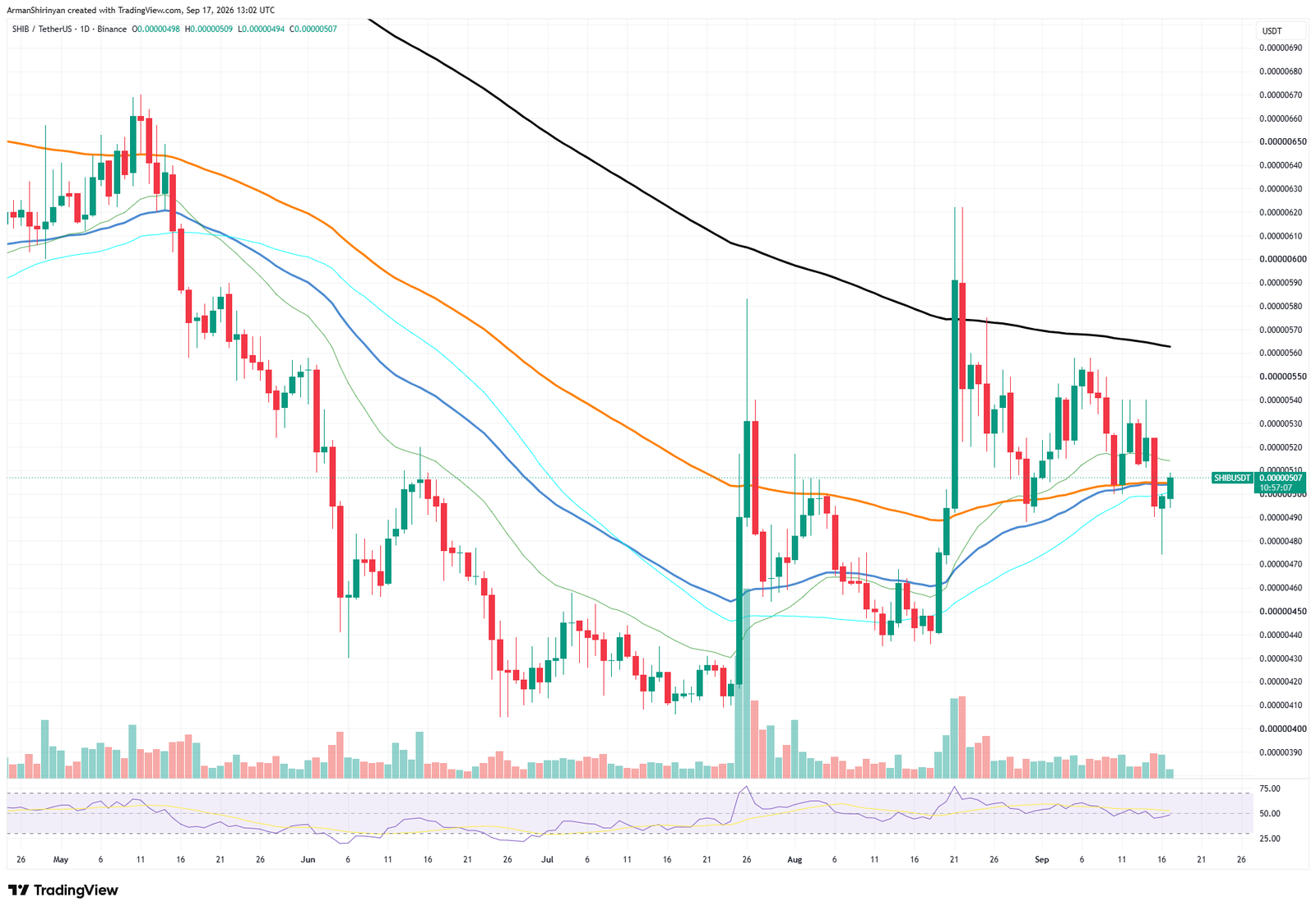
Sellers are continuously transferring more value out than buyers are bringing in over the specified time periods. Crucially, negative spot net flow does not always indicate that $SHIB is going to fail. Rather than being a precise prediction of future prices, these numbers reflect the equilibrium between buying and selling activity on tracked spot markets, depending on the methodology.
Price takes a plunge
That issue is reflected in the chart. At the moment, $SHIB is trading at about $0.00000507, directly between a number of short- and medium-term moving averages that are grouped around $0.00000495–$0.00000515. This results in a technical setup that is unusually compressed, where the next direction may be determined by relatively small price movements.
The first significant challenge is located between $0.00000515 and $0.00000520. $SHIB has frequently had trouble sustaining its momentum above this region. Stronger resistance is found between $0.00000540 and $0.00000550, which is followed by the declining long-term moving average close to $0.00000565.
On the downside, losing $0.00000490 would expose $0.00000460–$0.00000470 and significantly weaken the structure. The RSI is still close to the neutral 50 range, providing neither side with much momentum support.
As a result, $SHIB is experiencing a demand issue at the exact moment when its technical structure requires increased buying pressure. Another attempt to break above the moving-average cluster may find it difficult to develop into a sustained recovery unless spot flows improve.