
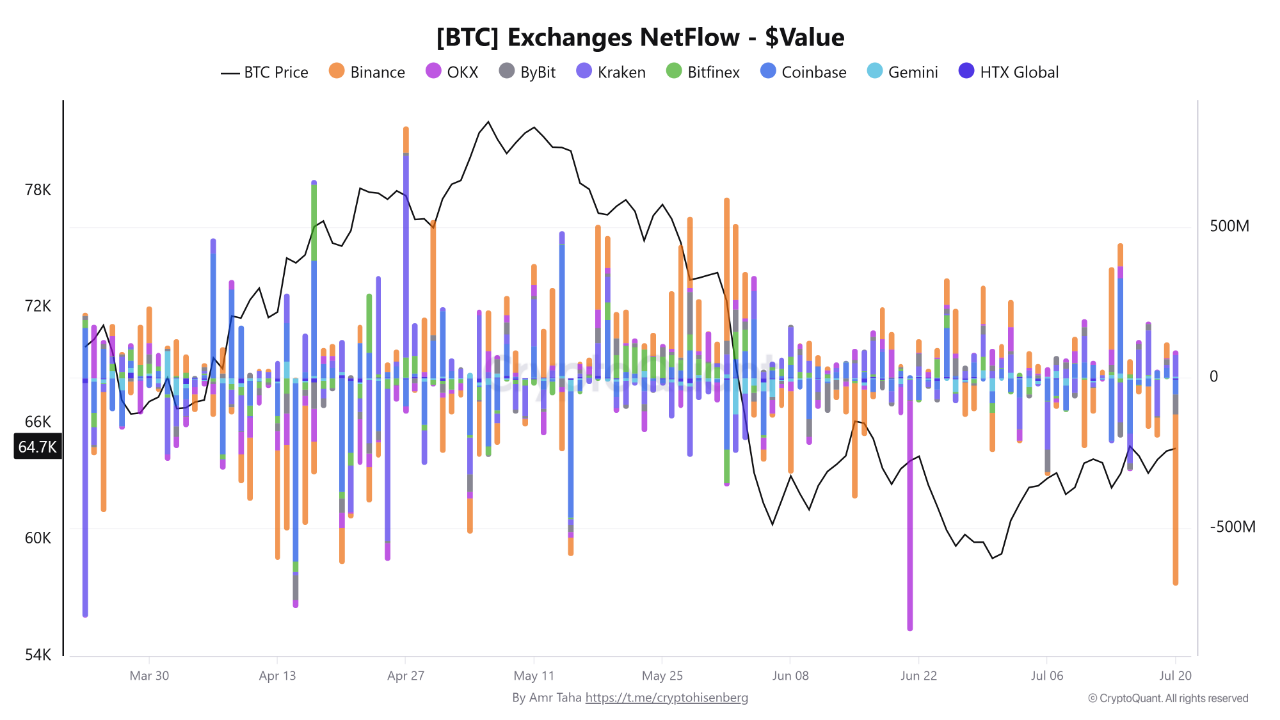
Bitcoin saw a broad wave of exchange outflows on July 20, with nearly $686 million worth of $BTC leaving major trading platforms.
CryptoQuant contributor Amr Taha highlighted this record in a recent commentary. Notably, Binance accounted for most of the withdrawals, recording its largest daily net outflow since April.
For context, if the coins remain off exchanges, the trend could help reduce short-term selling pressure. Interestingly, this new trend has emerged as Bitcoin’s price continues to stabilize, pushing up gradually,
Binance Drives Bitcoin Exchange Outflows
Taha said Binance recorded roughly $570 million in net Bitcoin outflows on July 20. It was the exchange’s largest daily negative netflow in about three months.
Meanwhile, the trend wasn’t limited to Binance. Bybit recorded about $65 million in net outflows, while Coinbase saw roughly $48 million leave the platform. HTX posted nearly $3 million in outflows.
Together, the four exchanges recorded around $686 million in Bitcoin withdrawals. According to Taha, the synchronized outflows suggest investors were moving Bitcoin off exchanges on a broad scale rather than reacting to a platform-specific event.
Falling Exchange Balances May Reduce Selling Pressure
Bitcoin leaving exchanges reduces the amount of $BTC immediately available for spot-market selling. If those coins stay in private wallets or long-term custody, lower exchange balances could ease near-term sell-side pressure.
Notably, large exchange outflows are often a sign of accumulation. However, they do not guarantee higher prices because the coins can always be transferred back to exchanges later.
Whale $BTC Selling Activity Slows
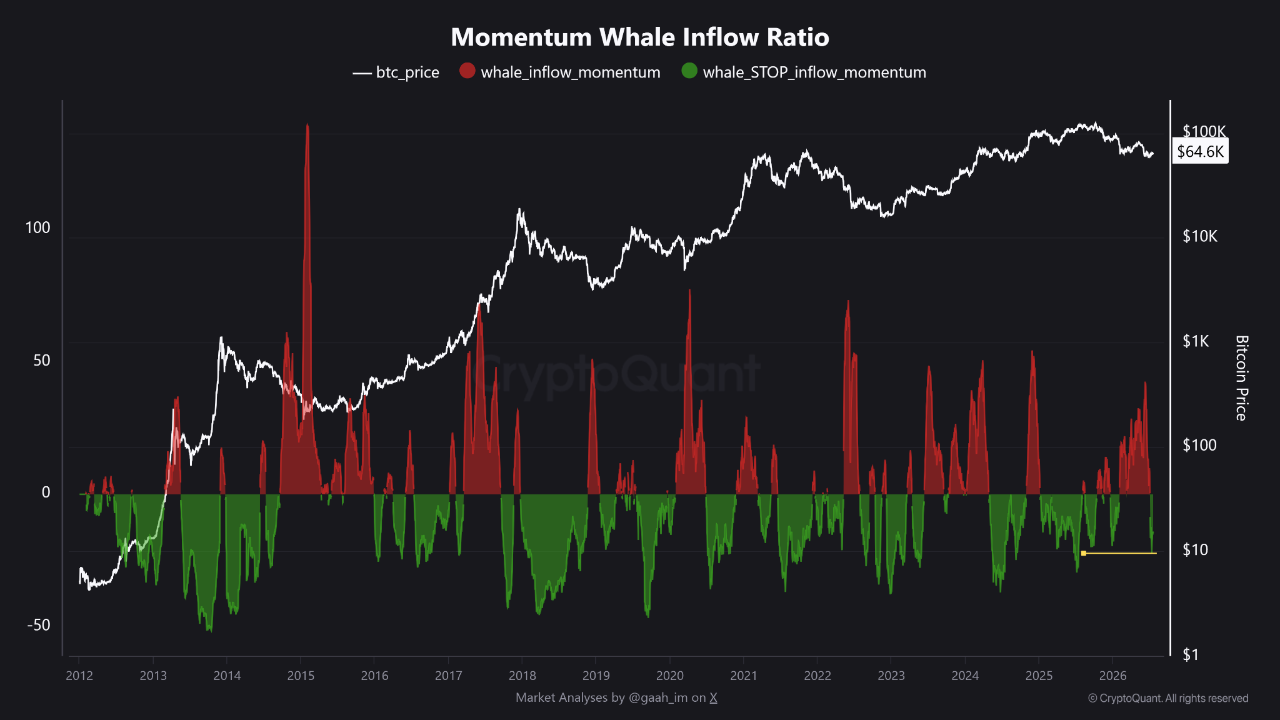
Separately, cryptoQuant contributor Gaah also pointed to another bullish on-chain signal. The Momentum Whale Inflow Ratio has turned negative for the first time in 2026 after staying positive for five straight months.
The metric tracks how much Bitcoin whales send to exchanges. A negative reading suggests large holders are depositing fewer coins for sale, indicating weaker selling pressure.
According to Gaah, the shift reduces bearish momentum and could support a short-term Bitcoin recovery if whale inflows remain low.
Bitcoin Extends Weekly Gains
At the time of writing, CoinMarketCap data showed Bitcoin trading at $65,800, up 2.55% over the past 24 hours.
The latest rally has pushed Bitcoin’s seven-day gain to 5%, while its 30-day performance has turned positive at 2.44%. Despite the recent rebound, Bitcoin is still down 25% year to date, suggesting the broader recovery remains a work in progress.
Notably, the ongoing rally is supported by continued U.S. spot Bitcoin ETF inflows, which totaled $227 million at the end of trading yesterday, led by BlackRock’s IBIT with a $116 million inflow on Monday.
Improved risk appetite also helped, as a rebound in Asian semiconductor stocks lifted global markets and pushed the total crypto market cap up 2.27%.