
The largest Bitcoin miners have effectively stopped selling their mined coins and switched to a strict holding mode, driven by a massive structural transformation across the entire industry. Over the past six months, public miners have collectively reduced their realized hashrate by 15%, completely shutting down around 56 EH/s of computing power.
Industry reports confirm that this move was not capitulation — companies are deliberately redirecting their resources toward high-performance computing (HPC) and AI infrastructure.
The "Biggest Unplug" charts clearly show who led this exodus: Cango and IREN disconnected 29.5 EH/s and 21.9 EH/s, respectively, during the first half of the year. These two players accounted for 68% of the total decline in capacity among public companies. Declines were also recorded at Cipher, Riot, TeraWulf, and CleanSpark.
However, this technological transformation is coming at an unprecedented cost to the industry: companies' combined spending on repurposing data centers for artificial intelligence has already exceeded $30 billion.
The capital expenditures of the six largest infrastructure providers on this transition have outpaced their current operating revenue by nearly 15 times.
The money for supercomputers has run out. In a good way.
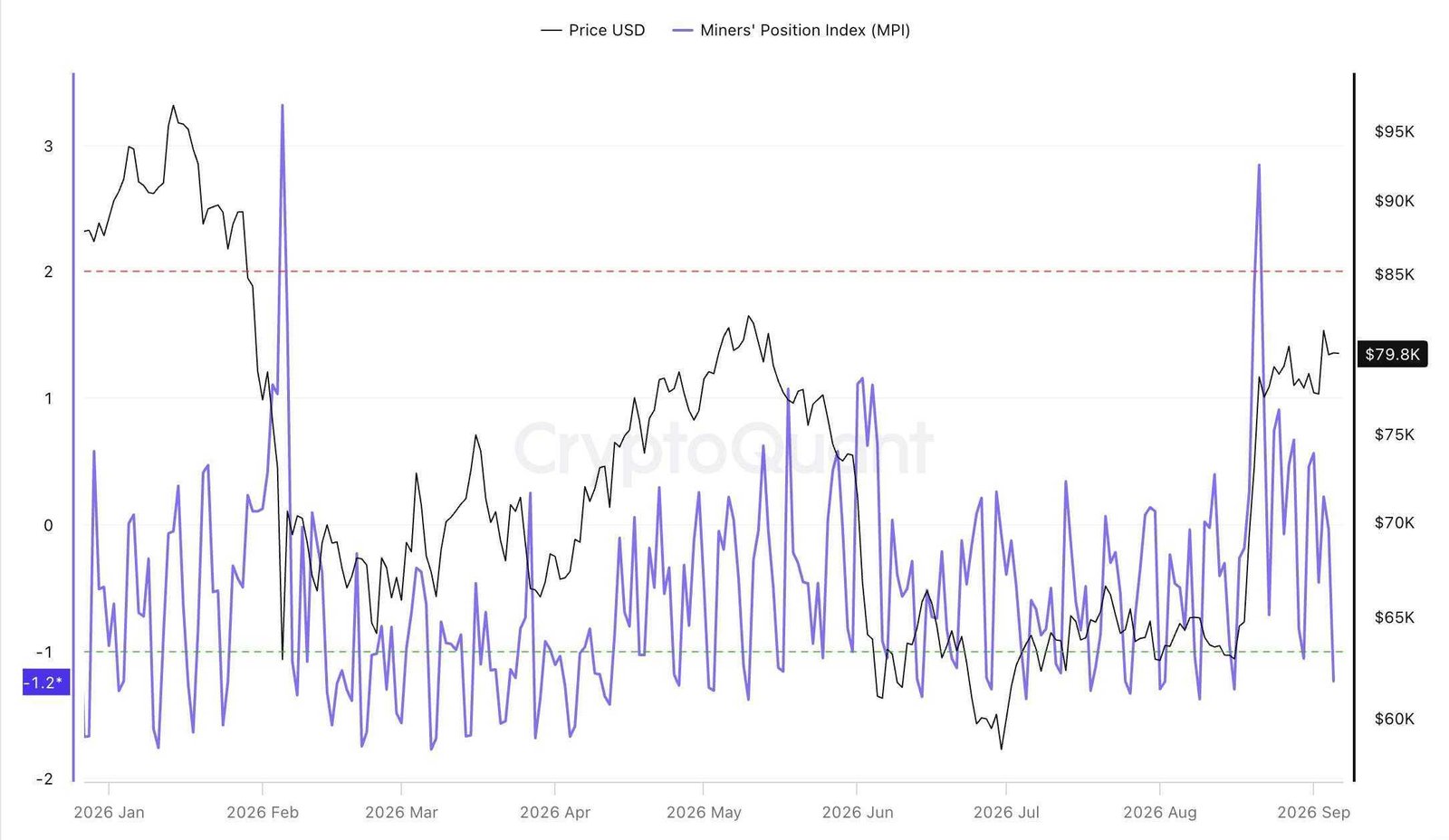
This enormous cash gap was exactly what forced miners to actively sell their mined Bitcoin during the summer rallies. Charts from the CryptoQuant platform show that during Bitcoin's August price surge, the Miner Position Index (MPI) briefly jumped to 2.8 — a level that traditionally indicates widespread profit-taking to cover ongoing expenses.
But once the main tranches for purchasing AI equipment were covered and the need to drain their crypto wallets disappeared, miners immediately hit pause.
According to fresh on-chain data from the Bitfinex exchange for September 2026, the MPI has collapsed to -1.2, well below the annual average. The flow of cryptocurrency from miners' wallets to exchanges has practically dried up.
The surge in selling turned out to be a one-off episode, and the index returned to deeply negative territory.
For the market, this is a strong fundamental signal: miners have stopped flooding exchanges with excess coins, settled into their new positions, and are simply waiting for more favorable prices, creating an effect of tightly constrained supply in the market.